

The AI Race Just Got a Lot More Interesting
Three of the world's most advanced AI models landed within weeks of each other. Anthropic released Claude Fable 5. OpenAI followed with GPT-5.6 Sol. Google shipped Gemini 3.6 Flash.
Each one promises to be the most capable model yet. Each one comes with its own story about safety and efficiency, and each one has an opinion about where AI work is headed next. And each one is competing for your attention and your budget.
If you are not a developer or engineer, keeping up with these announcements is a full-time job. This article does the work for you. We break down each model in plain language, compare them side by side, and share what our engineering team learned from testing them.
TL;DR
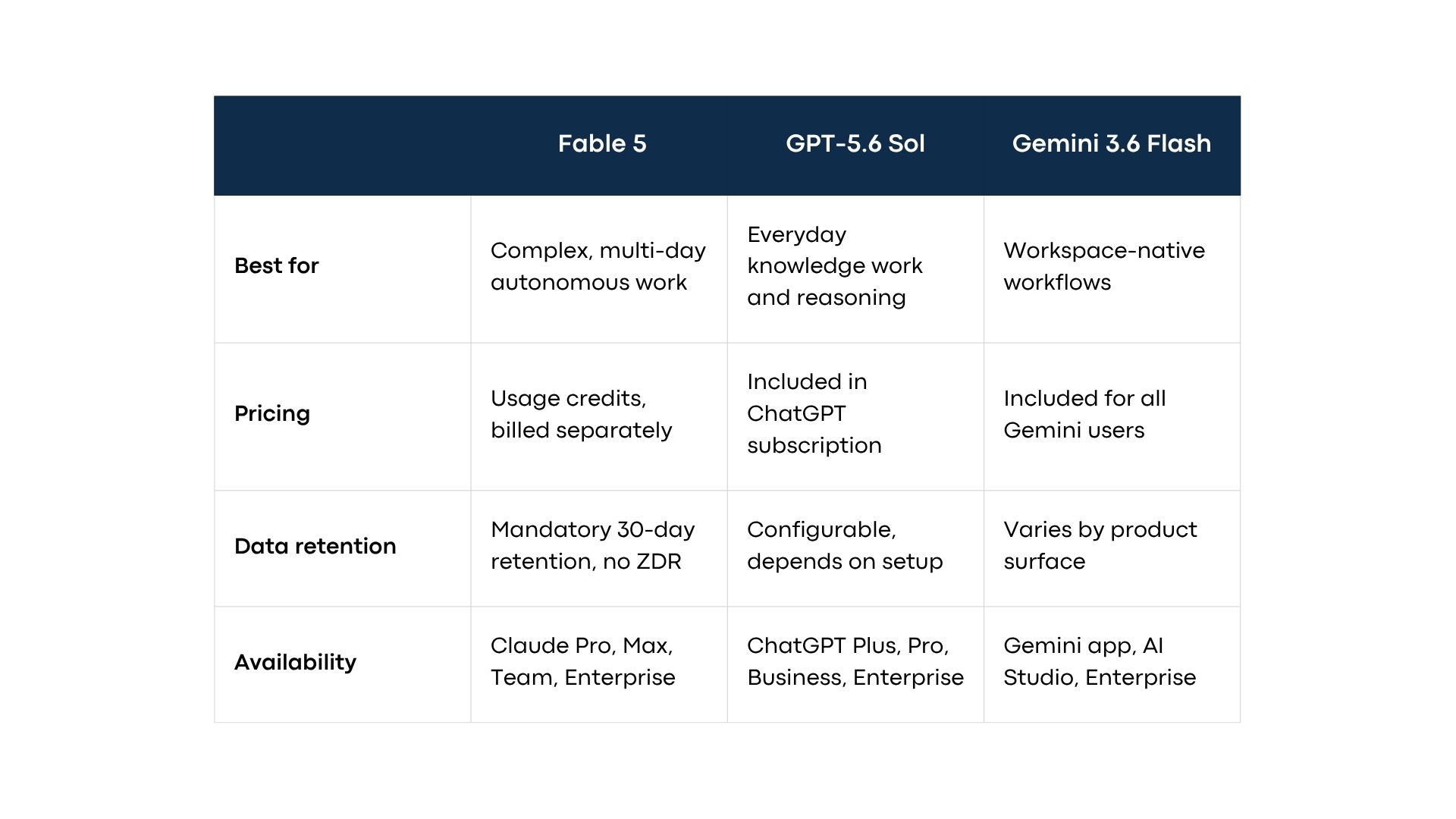
- Claude Fable 5 is Anthropic's most capable model, built for long, complex, autonomous work. It costs roughly double Opus 4.8 per token and carries a mandatory 30-day data retention period with no zero data retention option.
- GPT-5.6 Sol is OpenAI's new flagship, part of a three-tier family (Sol, Terra, Luna). It matches or beats Fable 5 on several benchmarks at a lower cost and is included in standard ChatGPT plans.
- Gemini 3.6 Flash is Google's efficiency play: cheaper and faster than its predecessor, built for teams already living in Google Workspace.
- None of these releases is a reason to switch vendors. The right move is matching the model to the task, not chasing the newest headline.

Claude Fable 5: Built for the Hardest Work
- What It Is
Claude Fable 5 is Anthropic's fifth-generation model, built for long-running, complex, and asynchronous work. Anthropic describes it as best suited for your most ambitious projects, meaning tasks that take days, not minutes.
Fable 5 sits at the top of Anthropic's lineup. It shares the same underlying architecture as Claude Mythos 5 but launches with stronger safeguards for general availability.
- Key Capabilities
The standout feature is autonomous execution over extended periods. Fable 5 can plan across multiple stages, delegate to sub-agents, write its own tests to check its work, and course-correct without being asked. Enterprise teams can hand off a large project and review the completed output rather than supervise every step.
On coding, it handles large-scale migrations, complex implementations, and multi-day sessions. One early customer, Stripe, used it to migrate a 50-million-line codebase in a single day. The model also reads diagrams, charts, and tables embedded in PDFs, which makes it a strong fit for finance, legal, and analytics work.
Fable 5 launched with the most robust safeguards Anthropic has applied to any model. In cybersecurity, biology, and chemistry, queries that trigger safety classifiers are automatically routed to Claude Opus 4.8. This approach was publicly tested when the US government briefly applied export controls to the model in June over a reported jailbreak concern. Anthropic patched the issue and restored access in July.
- What This Means for Your Team
Fable 5 is a specialist, and it should be used like one. For most daily work, Claude Opus handles the load well. Fable is for the highest-stakes tasks: large-scale technical projects, long-horizon analysis, and work where output quality justifies the extra investment.
One practical approach: use Opus to plan and structure what you want to accomplish, then bring Fable in to execute. That keeps your usage efficient while accessing Fable's full capability where it counts.
Two things to know before using it. First, Fable 5 requires usage credits billed separately from your standard Claude subscription, at roughly double the cost of Opus per token. Second, it carries a mandatory 30-day data retention requirement with no zero data retention option. For any work involving sensitive client information or confidential strategy, that is a meaningful consideration.
GPT-5.6 Sol: OpenAI's Most Competitive Release
- What It Is
GPT-5.6 Sol is OpenAI's flagship model in a new three-tier family. Sol handles frontier reasoning. Terra is designed for balanced everyday work. Luna is the fast, affordable option for high-volume tasks. The structure gives teams a clearer way to match the right model to the right job.
- Key Capabilities
The efficiency story defines GPT-5.6 Sol. It delivers performance competitive with Fable 5 across coding, reasoning, and knowledge work, while using significantly fewer tokens and completing tasks faster.
A setting called "ultra" mode lets Sol coordinate multiple agents working in parallel, which speeds up demanding tasks without requiring manual orchestration. For knowledge work, it pulls context from Gmail, Slack, Notion, Microsoft 365, and Google Drive to produce polished, expert-level outputs.
Cybersecurity is a major capability focus. Sol is significantly stronger than its predecessor at finding and fixing vulnerabilities. OpenAI paired expanded capability with a layered safety stack, including real-time monitoring and account-level review.
- What This Means for Your Team
GPT-5.6 Sol is the most accessible frontier model available right now. It is included in standard ChatGPT subscriptions, performs at or near Fable 5's level on most tasks, and does not carry the usage credit penalty.
For teams already inside the OpenAI ecosystem, Sol is a straightforward upgrade with no switching cost. Terra and Luna extend that value further. High-stakes reasoning goes to Sol. Standard daily workflows go to Terra. High-volume extraction, classification, or cleanup goes to Luna. Intentional routing across those tiers is where real efficiency gains live for organizations scaling AI across teams.
One note on data handling: Sol can be configured for zero data retention in an API setup, but that protection is not automatic. It depends on your account settings, which platform you are using, and which tools are connected. Confirm your setup before using it with sensitive information.
Gemini 3.6 Flash: Google's Efficiency-First Model
- What It Is
Gemini 3.6 Flash is Google's workhorse model, released recently alongside Gemini 3.5 Flash-Lite and a specialized cybersecurity model called 3.5 Flash Cyber. Google's focus here is efficiency at scale. The flagship Gemini 3.5 Pro is still in testing with partners.
- Key Capabilities
The most significant improvement is in agentic performance. Gemini 3.6 Flash uses 17% fewer output tokens than its predecessor and takes fewer steps to complete multi-step workflows. That directly lowers the cost of running AI agents in production. Computer use is now a built-in capability, available through the API and Gemini Enterprise.
In document-heavy environments, it shows meaningful gains in parsing, chart analysis, and report drafting. For teams managing large volumes of PDFs, spreadsheets, or mixed-format files, those gains translate to faster and more reliable outputs. The 3.5 Flash-Lite model, released alongside it, runs at 350 output tokens per second, making it one of the fastest options available for high-throughput tasks.
Google also confirmed it has started pre-training for Gemini 4. The next generation is already in motion.
Gemini 3.6 Flash is available across the Gemini app, Google AI Studio, and Gemini Enterprise. It is included at no additional cost for all Gemini users, including the free tier.
- What This Means for Your Team
For organizations running on Google Workspace, Gemini 3.6 Flash is worth a close look because it lives where much of your data already is. File organization, document summarization, spreadsheet work, and Drive-based knowledge management are natural fits.
For teams not embedded in the Google ecosystem, Fable 5 and GPT-5.6 Sol offer more immediate depth for complex reasoning and agentic execution. Gemini 3.5 Pro, when it arrives, will change that picture.
How They Compare
The SoftSnow Take: The Model Is the Last Decision
Every few weeks, one of the major labs releases something that claims the top benchmark spot. Then, within a short window, a competitor responds. Our engineering team has watched this cycle closely across all three recent releases, and the gap between these models keeps narrowing. The differences in capability are rarely large enough to justify overhauling your entire operation.
As one of our engineers put it: "I don't think it's to the point where one's dramatically better enough to switch your entire operation because of the model alone. It's more like the systems tied to your plan, or what your company data is already tied to."
That framing shifts the conversation in an important direction. The organizations getting real value from AI right now are the ones that started with a clear picture of their workflows. They identified where AI creates impact, designed around how their teams work, and chose tools that fit those needs. The model selection came after that work, not before it. This is the same pain-point-first approach we recommend to every client building an AI strategy.
Another member of our engineering team said it plainly: "At the end of the day, whatever vendor your company uses, I would not recommend switching just because of a model release. Eventually they will all be competing with one another."
What these three releases signal is the beginning of a model routing era. The right approach is to match the model to the task:
- Frontier models for hard reasoning and complex execution,
- Mid-tier models for daily knowledge work,
- Lightweight models for extraction, cleanup, and high-volume processing.
That routing logic only delivers value when you know what your teams are doing, where the friction is, and what level of output quality each task requires.
The right move is to stay current without getting pulled into constant tool-switching.
If you want to work through what these releases mean for your specific organization, let's talk. We can assess your current workflows, identify where AI creates the most immediate value, and build a strategy grounded in how your team works.
Frequently Asked Questions
- Should my company switch AI vendors because of these new models?
No. All three vendors are shipping competitive models at a rapid pace, and the gap between them is narrower than the headlines suggest. Switching vendors for a single model release usually costs more in disruption than it gains in capability. Base your decision on your existing systems, data, and workflows instead.
- When should I use Claude Fable 5 instead of Claude Opus?
Reserve Fable 5 for the highest-stakes work: large-scale technical migrations, long-horizon analysis, and tasks where the extra cost is justified by output quality. For most day-to-day work, Opus handles the load well and costs half as much per token.
- Is GPT-5.6 Sol better than Claude Fable 5?
It depends on the task. Each one wins on different types of work, and the gap between them is narrow overall. Sol tends to be stronger for long, multi-step tasks and hands-on technical work. Fable 5 tends to be stronger for fixing and improving existing code. On overall capability, the two are close enough that the difference rarely matters. For most teams, cost and how each one fits into your existing tools will matter more than which one scores slightly higher.
- What is Gemini 3.6 Flash best used for?
Gemini 3.6 Flash is strongest for teams already working inside Google Workspace: file organization, document summarization, spreadsheet cleanup, and Drive-based knowledge management. It is not positioned as a frontier reasoning model.